Who's the Best for Enterprise Imaging Solutions: Agfa HealthCare vs Medicai
Enterprise imaging teams often keep two separate vendors because no single platform handles both local and remote reading workflows without extra middleware. This decision now determines how fast a new clinic can go live and how much IT overhead the system will carry after launch.
By the end of this article you will see the exact storage, viewing, and sharing differences between the two vendors. You will also get a clear recommendation on which system aligns with multi-site setups versus single-hospital deployments.
Quick Verdict: Medicai vs Agfa HealthCare for Enterprise Imaging
Medicai provides a cloud-native enterprise imaging platform with zero-footprint DICOM viewer and 1.7M+ studies currently stored, while Agfa HealthCare offers traditional on-premise and hybrid enterprise solutions.
Cloud pricing versus enterprise licensing creates the first major difference between these platforms. Medicai operates on a subscription model that scales with usage. Agfa HealthCare typically requires substantial upfront investments plus ongoing maintenance contracts.
| Feature | Medicai | Agfa HealthCare |
|---|---|---|
| Pricing Model | Cloud subscription based on study volume | Traditional enterprise licensing with upfront costs |
| Storage Limits | 1.7M+ studies currently stored, 2M+ imaging studies uploaded | Limited by on-premise hardware capacity |
| Deployment Models | Cloud-native with Microsoft Azure partnership | Primarily on-premise and hybrid configurations |
| Integration Approaches | 50M+ yearly API transactions for EMR and EHR systems | Traditional HL7 and DICOM integrations |
Medicai processes 1M+ studies annually across 70 clinics and hospitals. The platform supports 10,000+ active doctors with 300k+ DICOM visualizations in the past year alone.
Deployment flexibility favors cloud solutions for organizations seeking reduced infrastructure burden. Traditional on-premise systems require dedicated IT teams and regular hardware upgrades.
Integration capabilities determine workflow efficiency across radiology departments. Medicai's API-first approach enables faster connections to existing EMR systems. Agfa HealthCare relies on established but sometimes slower integration methods.
At a glance: how Medicai compares to Agfa HealthCare on the features that matter most.
| Feature | Medicai | Agfa HealthCare |
|---|---|---|
| Enterprise Imaging Solutions | ✓ | ✓ |
What Is Medicai?
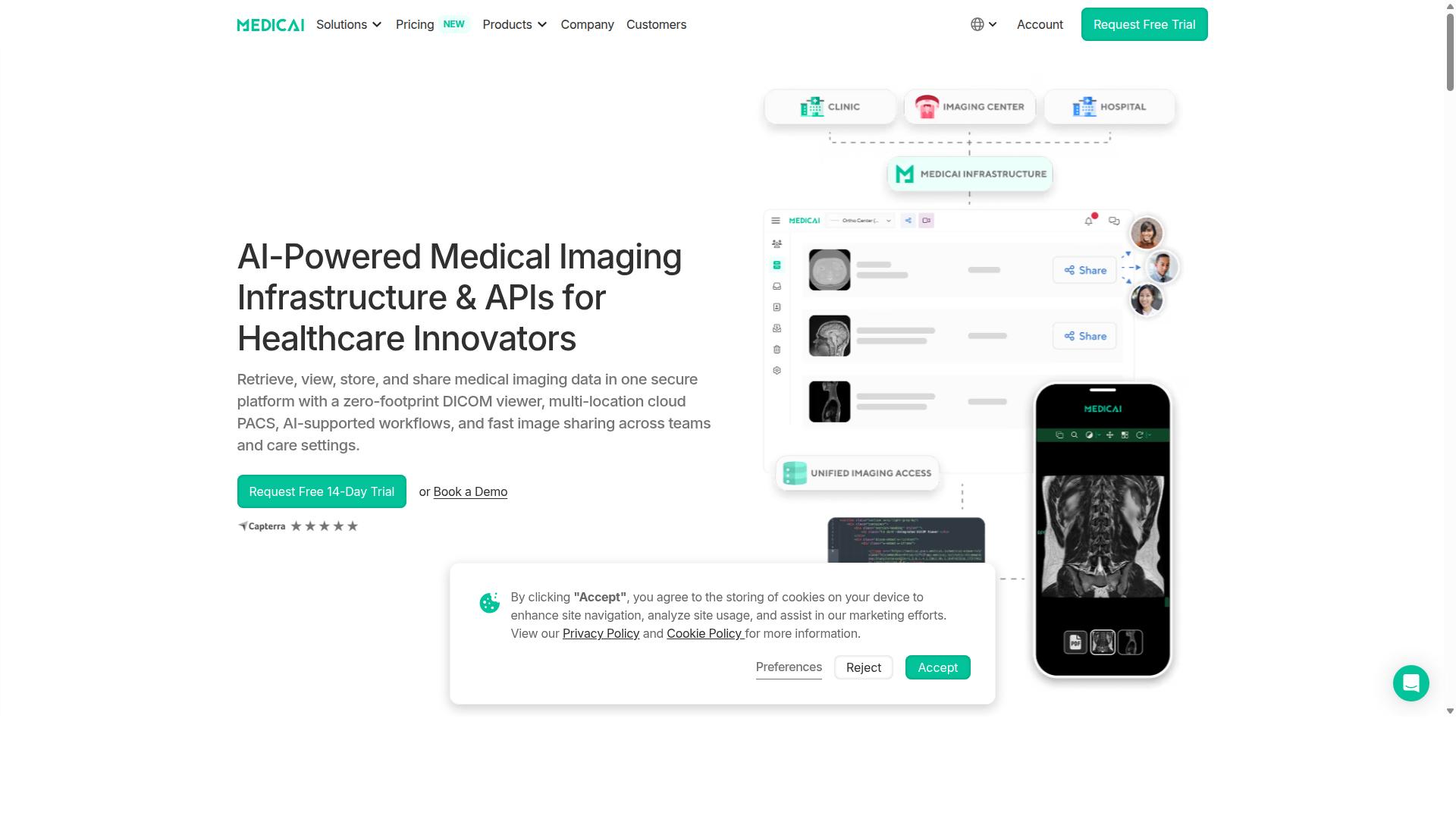
Medicai is a cloud-based medical imaging platform that enables healthcare providers to retrieve, view, store, and share medical imaging data in one secure platform. The system supports enterprise imaging needs across hospitals, clinics, and multi-site networks with a zero-footprint DICOM viewer built directly into the workflow.
Four primary modules organize the platform capabilities. CONNECT & RETRIEVE gathers studies from external sources. STORE & MANAGE handles secure archiving in the cloud PACS environment. ACCESS provides controlled entry for authorized users. VIEW delivers imaging review through the integrated zero-footprint viewer.
Compliance standards include HIPAA and GDPR requirements for patient data protection. FDA and CEE clearance confirms the platform meets medical device regulations for diagnostic use. These certifications support deployment in regulated healthcare environments.
Imaging Infrastructure as a Service (IIaaS) forms the core architecture. This model allows organizations to scale storage and processing without on-premise hardware investments. The approach suits radiology departments that need flexibility across different facility sizes and locations.
Interoperability remains central to the design. The platform supports standard medical imaging formats and protocols that connect with existing hospital systems. Healthcare providers can integrate imaging workflows without replacing current infrastructure completely.
What Is Agfa HealthCare?
Agfa HealthCare is a long-established medical imaging vendor providing enterprise PACS, RIS, and VNA solutions primarily deployed on-premise or in hybrid configurations.
The company serves hospitals and imaging centers that need established systems for radiology workflow and image management. Its enterprise imaging platforms handle diagnostic imaging across multiple departments and support traditional on-premise infrastructure.
Agfa HealthCare solutions typically include PACS for image storage and retrieval, RIS for scheduling and reporting, and VNA capabilities for long-term archive management. These systems generally operate within hospital data centers or through hybrid cloud arrangements.
Integration with existing EMR systems often requires HL7 interfaces and DICOM connectivity. Large health systems with extensive on-premise IT infrastructure may find these traditional deployment models familiar and suitable for their needs.
When comparing enterprise imaging vendors, organizations should evaluate factors such as deployment flexibility, integration capabilities, and ongoing maintenance requirements. Cloud-based platforms like Medicai offer different advantages in areas such as remote access and reduced infrastructure burden.
Features Compared
Feature-by-feature analysis highlights key differences in deployment flexibility, integration depth, and workflow automation between the two platforms.
Enterprise imaging teams need solutions that scale across multiple sites while maintaining security and compliance standards. The following three areas show where each platform takes a different approach.
Storage architecture affects both cost and access speed. Integration capabilities determine how well systems connect with existing hospital infrastructure. Workflow tools influence daily productivity for radiologists and referring physicians.
Cloud PACS and Multi-Location Storage
Medicai's Cloud PACS provisions 500 GB at Starter tier and 2 TB at Standard tier with scalable multi-site connectivity, whereas Agfa typically relies on on-premise or private-cloud VNA deployments.
Medicai offers a Vendor Neutral Archive that supports backup and disaster recovery across connected locations. This structure allows healthcare organizations to expand storage without additional hardware investments at each facility.
The platform handles 1.7M+ studies in storage and 2M+ imaging studies uploaded across 70 clinics and hospitals. Multi-location access reduces delays when physicians at different sites need the same patient records.
Agfa's approach usually requires dedicated servers or private cloud infrastructure at each location. This setup creates higher upfront costs and ongoing maintenance responsibilities for IT teams.
Zero-Footprint DICOM Viewer and Image Sharing
Medicai's zero-footprint DICOM viewer supports 300k+ visualizations annually and enables instant image exchange across institutions without local software installation.
Medicai Medical Image Exchange and Patient Case Management tools allow secure transfer between facilities. These features support teleradiology workflows and reduce the need for physical media or manual file transfers.
The system maintains HIPAA and GDPR compliance with data encryption and audit trails. Role-based access controls ensure that only authorized users can view or share specific studies.
Agfa provides image-sharing capabilities through its enterprise platform, though these tools often require additional configuration or local client software. Organizations may need separate solutions for external sharing with referring physicians or patients.
AI-Supported Workflows and API Integration
Medicai processes 50M+ yearly API transactions and integrates with AI partners such as MD.ai and Rayscape.ai, while Agfa offers configurable AI connectors within its enterprise ecosystem.
Medicai Imaging API supports connection with existing EMR and EHR systems through standard protocols. The platform connects with 10,000+ active doctors who use these integrations for daily clinical workflows.
Partnerships with Microsoft Azure, Hetzner, and Amazon AWS provide the infrastructure foundation for these AI capabilities. Structured Reporting for Radiology and AI-Powered Diagnostics tools help reduce diagnosis time by 65 percent according to platform reports.
Agfa includes AI options within its broader enterprise imaging suite, though specific integration partners and transaction volumes are not publicly detailed. Both platforms support machine learning radiology applications, but Medicai's documented API scale and partner network provide clearer implementation pathways for organizations ready to deploy AI tools now.
Pricing Compared
Medicai publishes transparent monthly subscriptions starting at $249 for 500 GB storage and $749 for 2 TB, while Agfa follows traditional enterprise licensing quotes. These price structures reflect different approaches to how organizations acquire medical imaging technology.
The Starter plan at $249 per month includes 500 GB cloud storage with unlimited user accounts and no connected locations. The Standard plan at $749 per month provides 2 TB cloud storage with unlimited user accounts and one connected location. Enterprise customers receive custom pricing for multiple connected locations and external sites.
Organizations choosing yearly billing receive 15 percent savings, bringing the Starter plan to $209 monthly and the Standard plan to $639 monthly. DICOM Gateway setup costs $1,000 as a one-time fee per location. A 14-day trial of Starter plan features comes with no credit card requirement.
Per-study pricing options exist for enterprise customers who need flexible usage models. Enterprise plans accommodate custom cloud storage volumes and support multiple external locations across different facilities.
Agfa pricing remains quote-based and varies by module and deployment scope. This approach typically requires detailed consultations to determine costs, which can extend decision timelines for healthcare organizations evaluating enterprise imaging solutions.
Who Should Choose Medicai
Organizations seeking rapid deployment, transparent costs, and cloud scalability should evaluate Medicai for multi-specialty imaging workflows. Hospitals and imaging centers often face delays when traditional systems require lengthy installation and configuration. Medicai addresses this need through its cloud-native architecture, allowing teams to begin working within days rather than months.
Specialty care providers in orthopedics, neurology, oncology, and cardiology benefit from zero-footprint access that eliminates workstation restrictions. These groups frequently manage distributed teams across multiple locations. Remote radiologists, tumor boards, and clinical trial coordinators can review studies from any device with internet connectivity without installing specialized software.
Virtual care providers and telemedicine platforms require flexible image exchange capabilities. Medicai supports teleradiology services by enabling secure study sharing between referring physicians and specialists. Personal injury lawyers also use the platform to access and review medical imaging for case documentation.
Medical education organizations and ob-gyn, pulmonology, dentistry, and gastroenterology practices find value in the patient portal feature. This allows patients to view their own imaging studies directly. The platform accommodates the diverse needs of radiology, ophthalmology, and other specialties without requiring separate systems for each department.
Who Should Choose Agfa HealthCare
Large health systems requiring deeply customized on-premise or hybrid enterprise imaging stacks with extensive RIS/PACS integration may prefer Agfa's traditional model. These organizations often maintain complex legacy infrastructure that demands specialized configuration and vendor-managed hardware.
Academic medical centers and government facilities frequently operate under strict procurement rules. They need solutions that align with existing vendor relationships and multi-year capital budgets. Agfa has built a reputation for delivering extensive customization options within these environments.
Health networks managing high-volume radiology departments across multiple physical locations often seek vendor-neutral archives and diagnostic workstations with proven interoperability. These buyers typically prioritize established HIPAA compliance frameworks and HL7 integration capabilities that have been tested across decades of deployments.
Regional health systems with dedicated IT teams may also favor Agfa when they require on-premise imaging solutions that integrate tightly with existing EMR systems. Such organizations usually allocate significant resources to maintain and support complex medical imaging infrastructure.
Enterprises handling specialized modalities that demand custom workflow configurations often select traditional vendors like Agfa. These buyers typically value direct control over data storage locations and prefer established audit trail mechanisms that meet their internal security policies.
Final Verdict
For cloud-first deployments and predictable monthly costs, Medicai provides measurable advantages. Agfa remains viable for organizations committed to on-premise enterprise infrastructure.
Key decision factors center on deployment model, transaction volume, and compliance needs. Medicai processes 1M+ studies per year and stores 1.7M+ studies with 50M+ API transactions annually.
Organizations handling high-volume enterprise imaging benefit from these metrics. 300k+ DICOM visualizations in the last year demonstrate consistent clinical demand across 70 clinics and hospitals.
Cloud scalability supports multi-site deployments without infrastructure overhead. 10,000+ active doctors already use the platform for image exchange and teleradiology workflows.
Compliance requirements favor platforms with established certifications. Medicai follows HIPAA and GDPR compliance standards with FDA/CEE cleared viewers and OWASP security guidelines.
The recommendation framework depends on three factors. Choose Medicai for cloud imaging, regular API integrations with EMR systems, and predictable operational costs. Select Agfa when existing contracts mandate on-premise PACS maintenance.